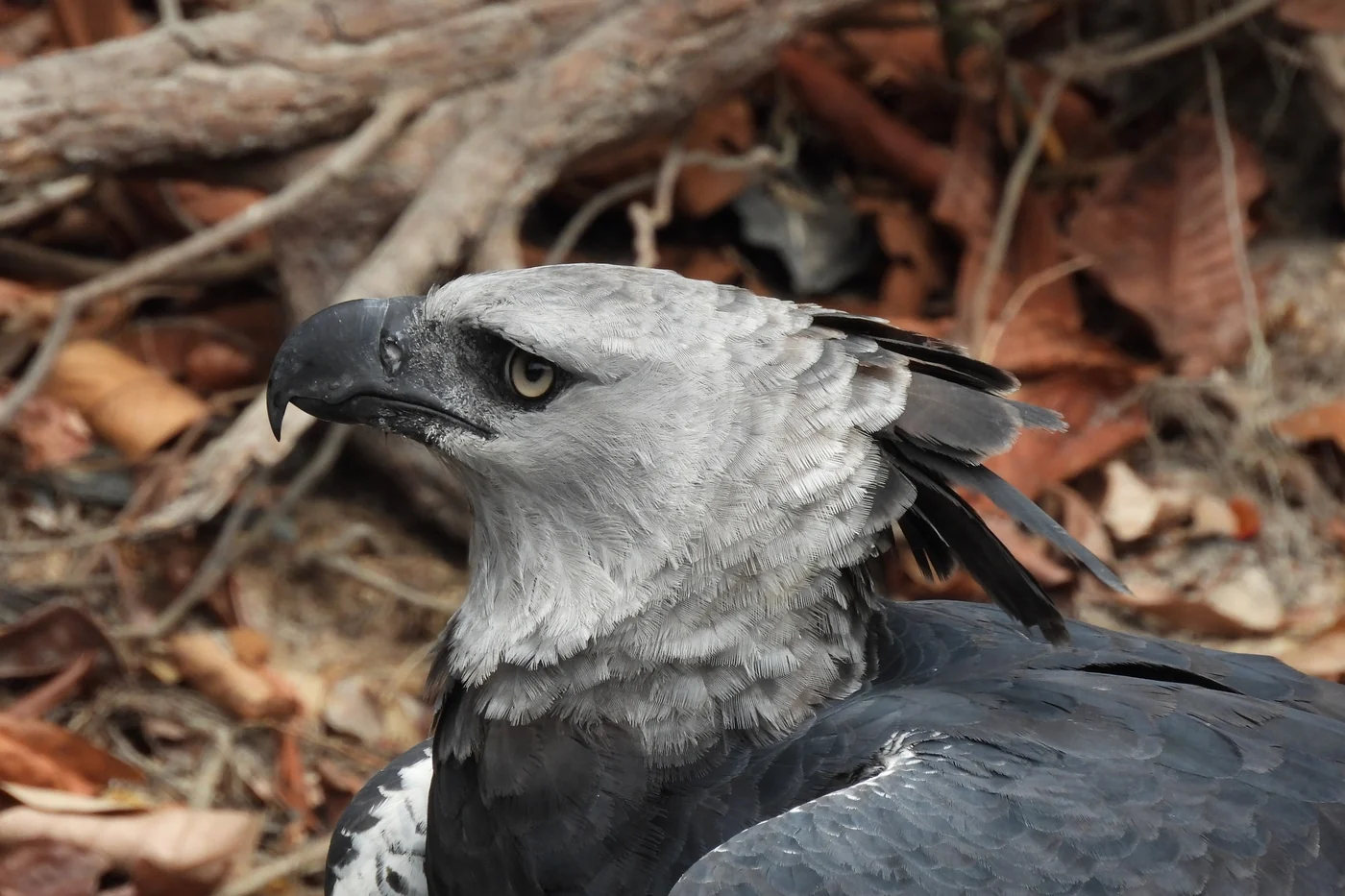
Harpy Eagle
Harpia harpyja
Talon-crowned apex raptor ruling the emergent canopy of Neotropical rainforests
Quick Read
AccipitridaeOverview
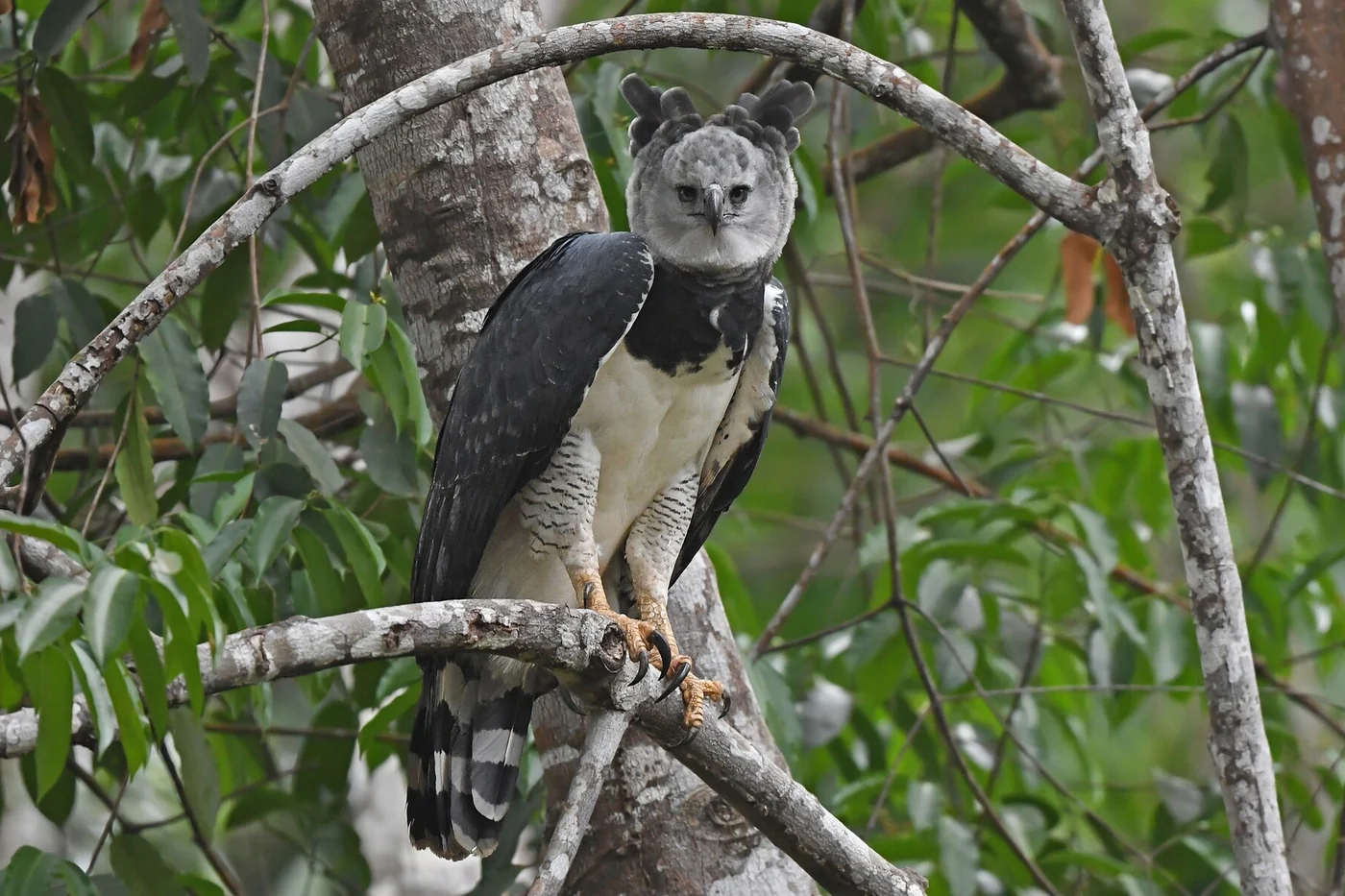
Crowned with a striking split double crest and armed with rear talons rivaling grizzly bear claws, the Harpy Eagle is the supreme aerial predator of the Americas' tropical forests. Built for power and tight canopy agility rather than open-sky soaring, it hunts sloths and monkeys across vast territories of primary rainforest.
Habitat & Range
The Harpy Eagle (Harpia harpyja) inhabits lowland tropical rainforests across the Neotropics, historically extending from southern Mexico through Central America and across South America to northern Argentina. Today, Mesoamerican populations are severely fragmented, with major strongholds confined to Panama's Darién region, the Maya Forest mosaic, and northeastern Honduras, while the core global population persists across the Amazon Basin and Guiana Shield in Colombia, Venezuela, Guyana, Suriname, French Guiana, Ecuador, Peru, Bolivia, and Brazil, alongside small remnant pockets in Brazil's Atlantic Forest and Misiones, Argentina. Strictly tied to tall, unbroken primary forest, the species occurs predominantly below 900 meters elevation, though individuals occasionally forage along forested Andean foothills up to roughly 2,000 meters.
How to Identify It
Among the heaviest and most powerful raptors on Earth, the Harpy Eagle exhibits striking reverse sexual dimorphism: adult females weigh 6.0 to 9.0 kilograms, nearly twice the mass of males at 4.0 to 5.5 kilograms. Body length spans 86.5 to 107 centimeters, while the wingspan measures a relatively compact 176 to 224 centimeters, forming broad, rounded wings tailored for tight forest maneuvering. Adults feature slate-black upperparts, a bold black breast band over a white belly, and white thighs finely barred with black. A pale ash-gray head bears a prominent split double crest and a movable facial ruff of stiff feathers. Its yellow tarsi can be as thick as a human wrist, terminating in curved rear talons measuring 10 to 13 centimeters.
Diet & Hunting
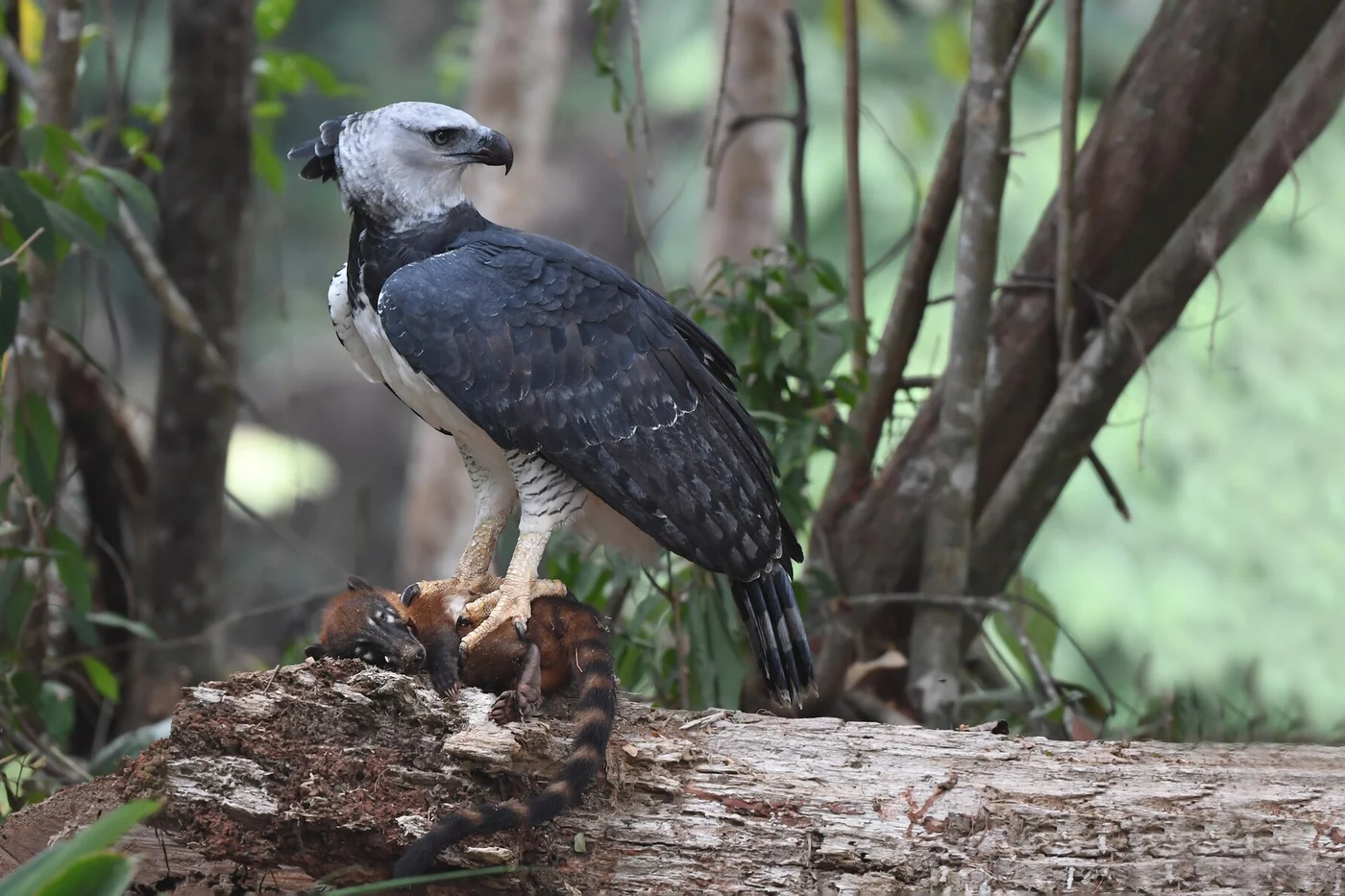
A specialized predator of medium-sized arboreal vertebrates, the Harpy Eagle derives the majority of its diet from canopy-dwelling mammals. Two-toed sloths (Choloepus spp.) and three-toed sloths (Bradypus spp.) frequently account for more than half of recorded prey items across Amazonian nest studies, supplemented heavily by howler monkeys, capuchins, spider monkeys, squirrel monkeys, saki monkeys, tree porcupines, kinkajous, coatis, and opossums. Smaller males tend to capture lighter, agile primates and large birds such as macaws or curassows, whereas heavier females regularly take adult sloths and howler monkeys weighing up to 6 or 7 kilograms, reducing intersexual competition within shared territories. Striking at burst speeds up to 80 kilometers per hour, its immense grip pressure dispatches prey almost instantaneously.
Behavior
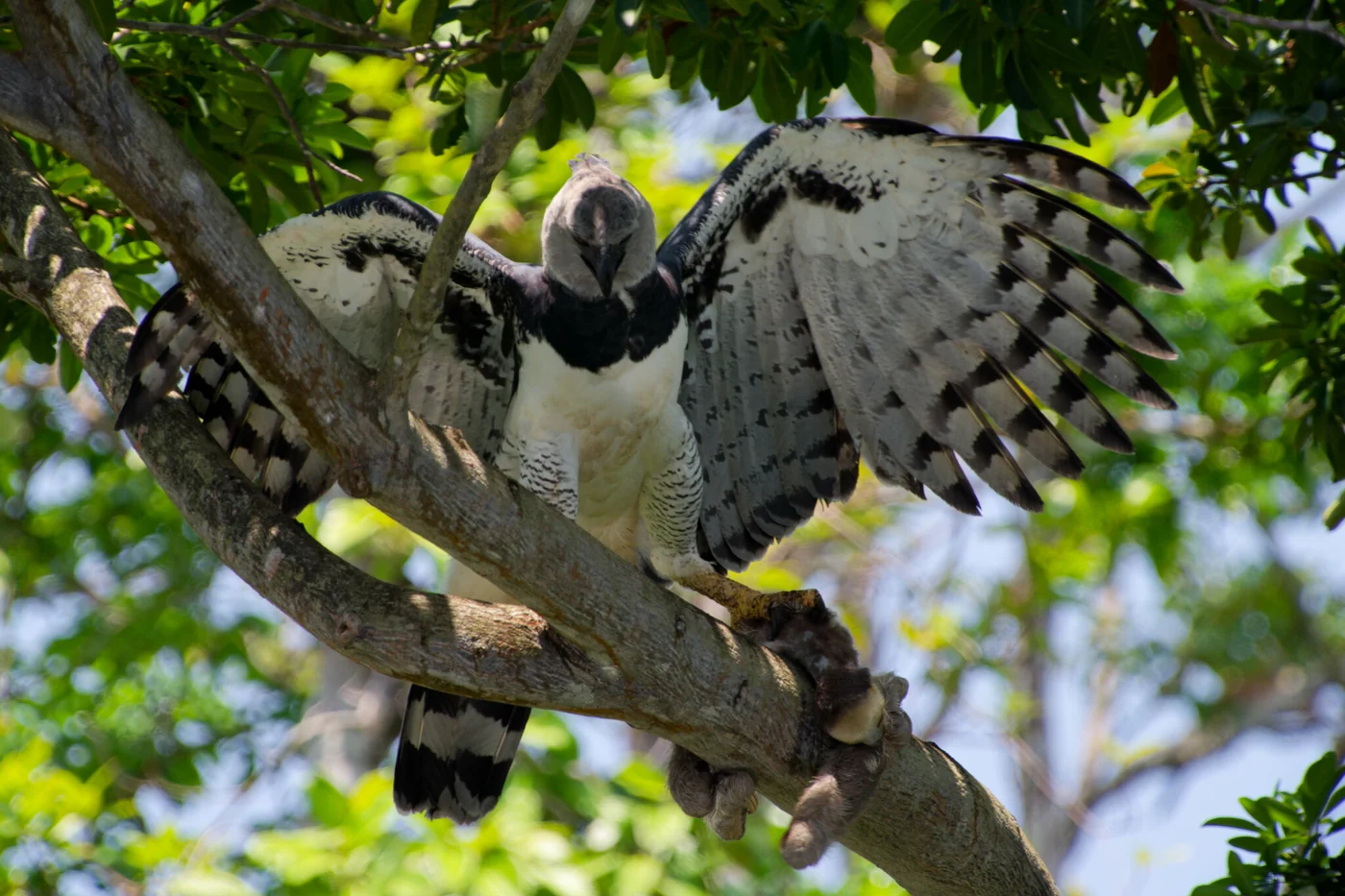
Despite its imposing size, the Harpy Eagle is an elusive, quiet ambush hunter that spends hours perched motionlessly on high interior limbs beneath the emergent crown, scanning surrounding foliage with acute vision and owl-like acoustic focusing. Rather than soaring on open thermals like steppe or sea eagles, it hunts via short perch-to-perch flights beneath and through the canopy, using its long black-and-gray banded tail as an aerodynamic rudder to pivot sharply around trunks and lianas. Adult pairs are territorial and generally monogamous, defending home ranges spanning roughly 30 to over 100 square kilometers depending on prey density. Outside the immediate nest tree—where adults emit piercing nasal wails and resonant goose-like calls—the species remains remarkably silent.
Life Cycle
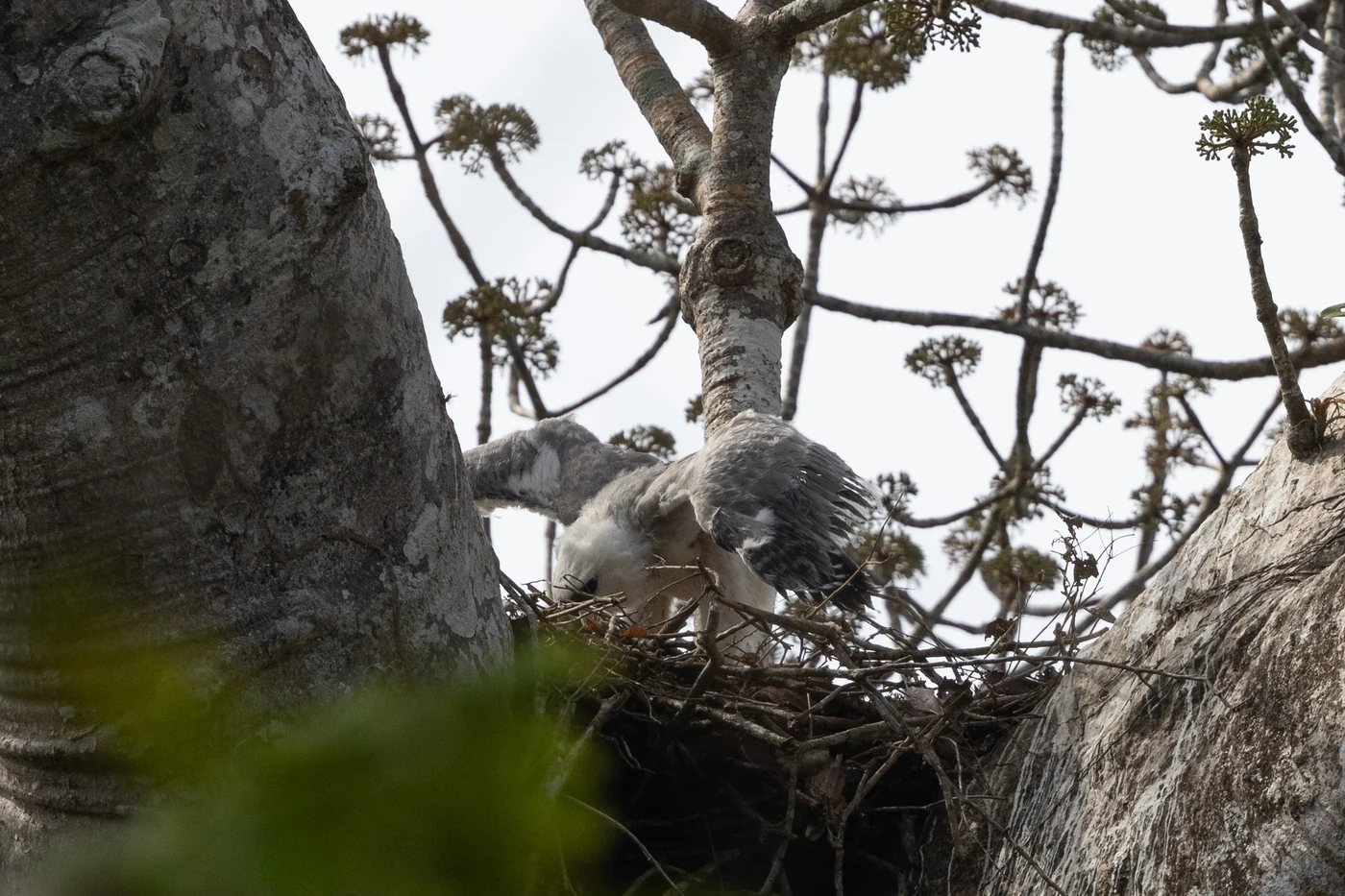
Harpy Eagles have one of the longest breeding cycles of any bird on Earth, producing a single surviving offspring only once every two to three years. Pairs construct a monumental platform of sticks up to 1.5 meters wide and 1.2 meters deep in the main fork of an emergent giant—most often kapok (Ceiba pentandra) or Brazil nut (Bertholletia excelsa) trees standing 30 to 50 meters tall—reusing and expanding the same nest across decades. The female lays one or two dull white eggs, but once the first egg hatches after roughly 56 days of incubation, the second egg is rarely tended further. The chick fledges at five to six months yet relies on parental food deliveries for another 10 to 12 months, reaching sexual maturity at four to six years.
Role in the Ecosystem
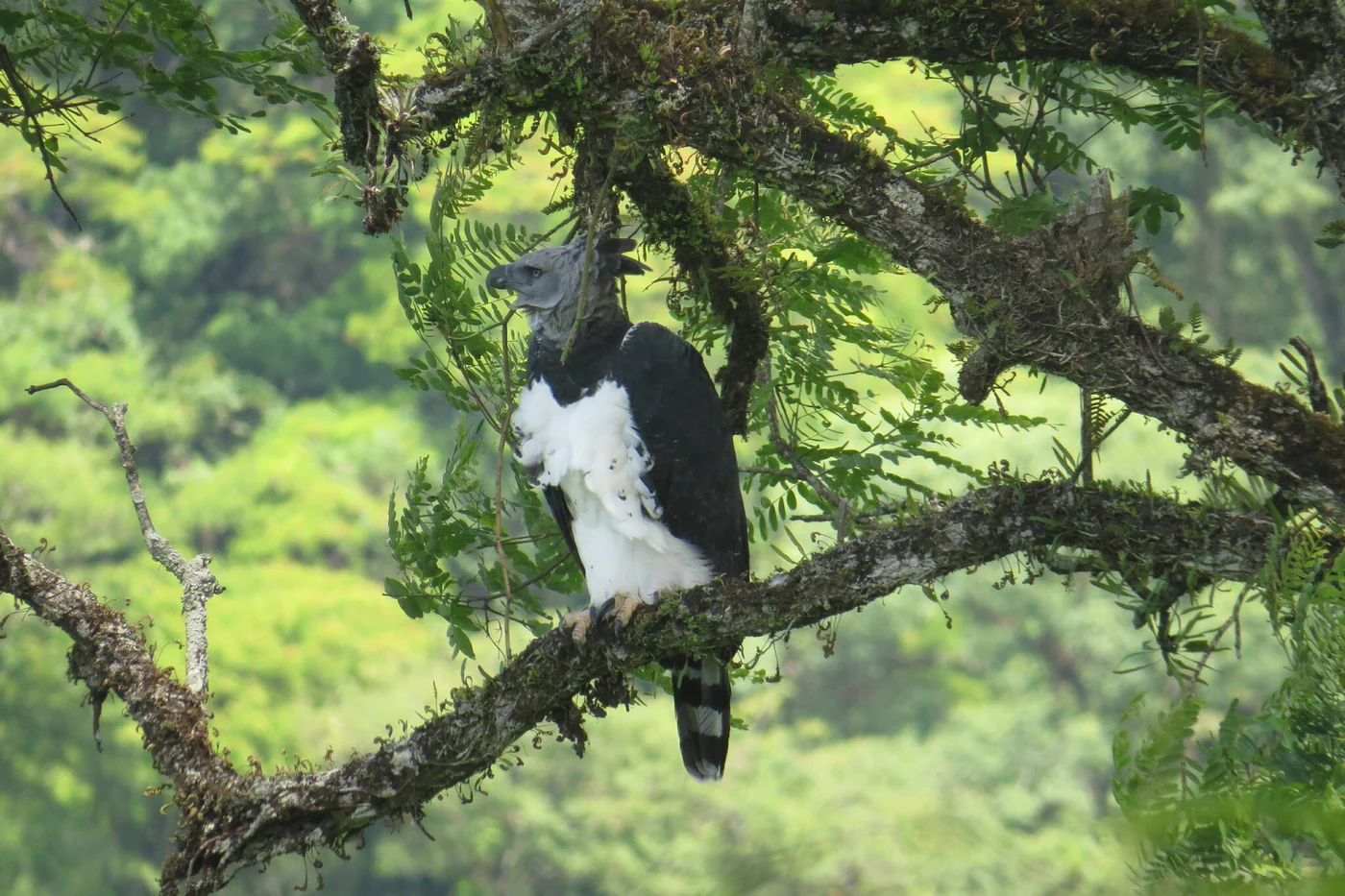
Operating at the apex of the Neotropical canopy food web, the Harpy Eagle exerts top-down ecological control over arboreal folivores and mesopredatory omnivores. By regulating densities of sloths, howler monkeys, and capuchins, breeding pairs prevent localized overbrowsing of canopy trees and curb excessive nest predation by medium-sized primates on songbirds and fruiting plants. Because Harpy Eagles require vast tracts of tall emergent trees and abundant mammal communities, ecologists regard them as both an umbrella species and a sensitive bioindicator of intact lowland rainforest integrity.
Conservation Outlook
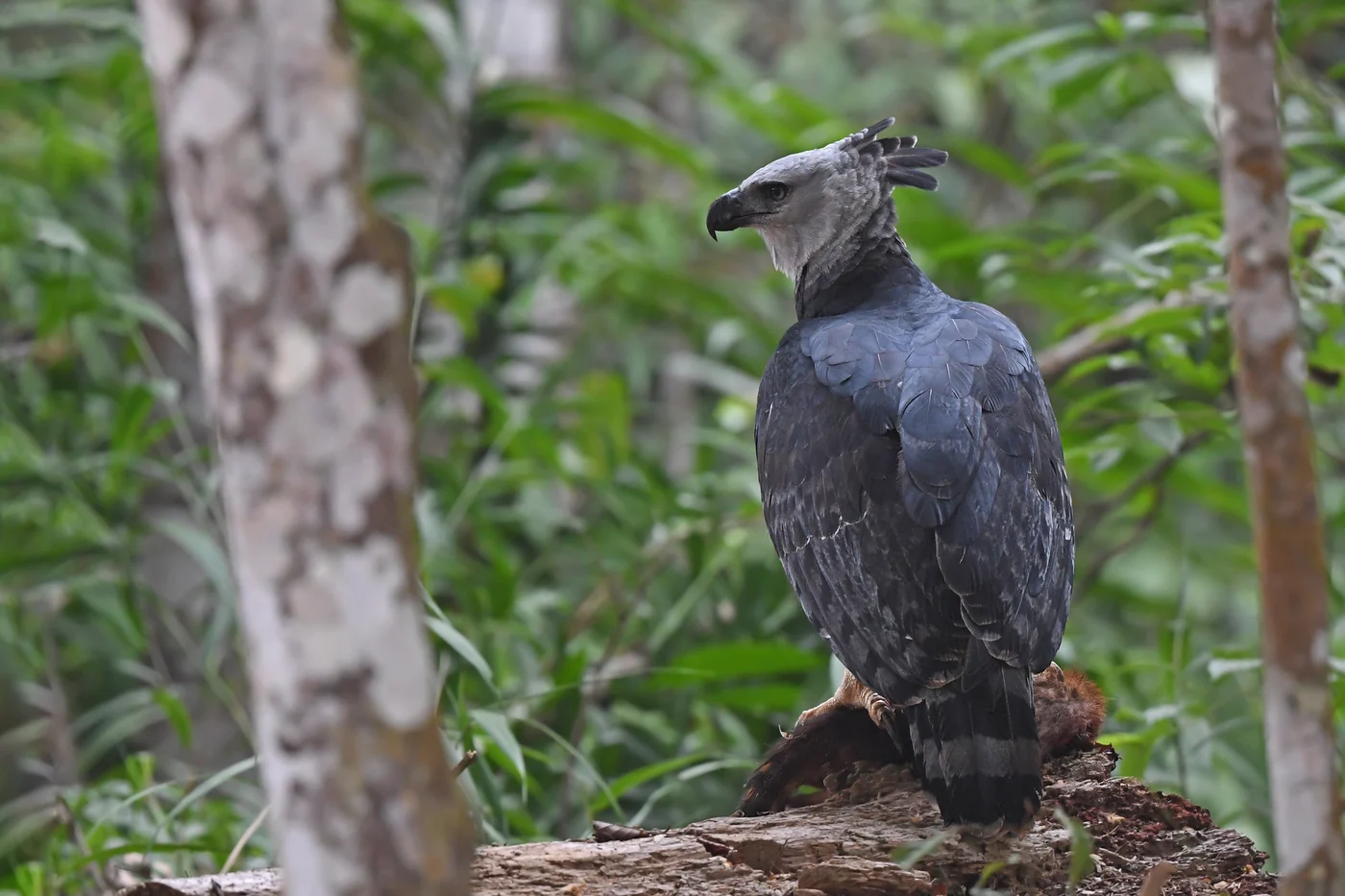
Classified as Vulnerable (VU) on the IUCN Red List and listed under CITES Appendix I, the Harpy Eagle faces a continuing global decline driven primarily by rapid deforestation for cattle ranching, industrial soy agriculture, selective logging of emergent nest trees, and road expansion, compounded by direct shooting out of fear or curiosity near frontier settlements. The species has vanished from large portions of Central America and Brazil's Atlantic Forest. Critical refuges include Darién National Park in Panama—where the Harpy Eagle is honored as the national bird—Manu National Park and Tambopata in Peru, Yasuní in Ecuador, and the Central Amazon Conservation Complex in Brazil. Active nest-mapping, satellite telemetry, captive-release pioneers by The Peregrine Fund, and Indigenous community stewardship led by Projeto Gavião-real continue to protect active breeding trees.
Key Takeaways
- 1
Its rear hallux talons reach 10 to 13 centimeters in length, matching or exceeding the claws of an adult grizzly bear.
- 2
Females weigh up to 9 kilograms—nearly double the weight of males—allowing mated pairs to partition different canopy prey sizes.
- 3
Pairs raise only a single chick every two to three years, feeding the fledgling for up to a full year after its first flight.