Red Panda
Ailurus fulgens
Solitary bamboo acrobat and last living Ailurid of the misty Eastern Himalayan cloud forests
Quick Read
AiluridaeOverview
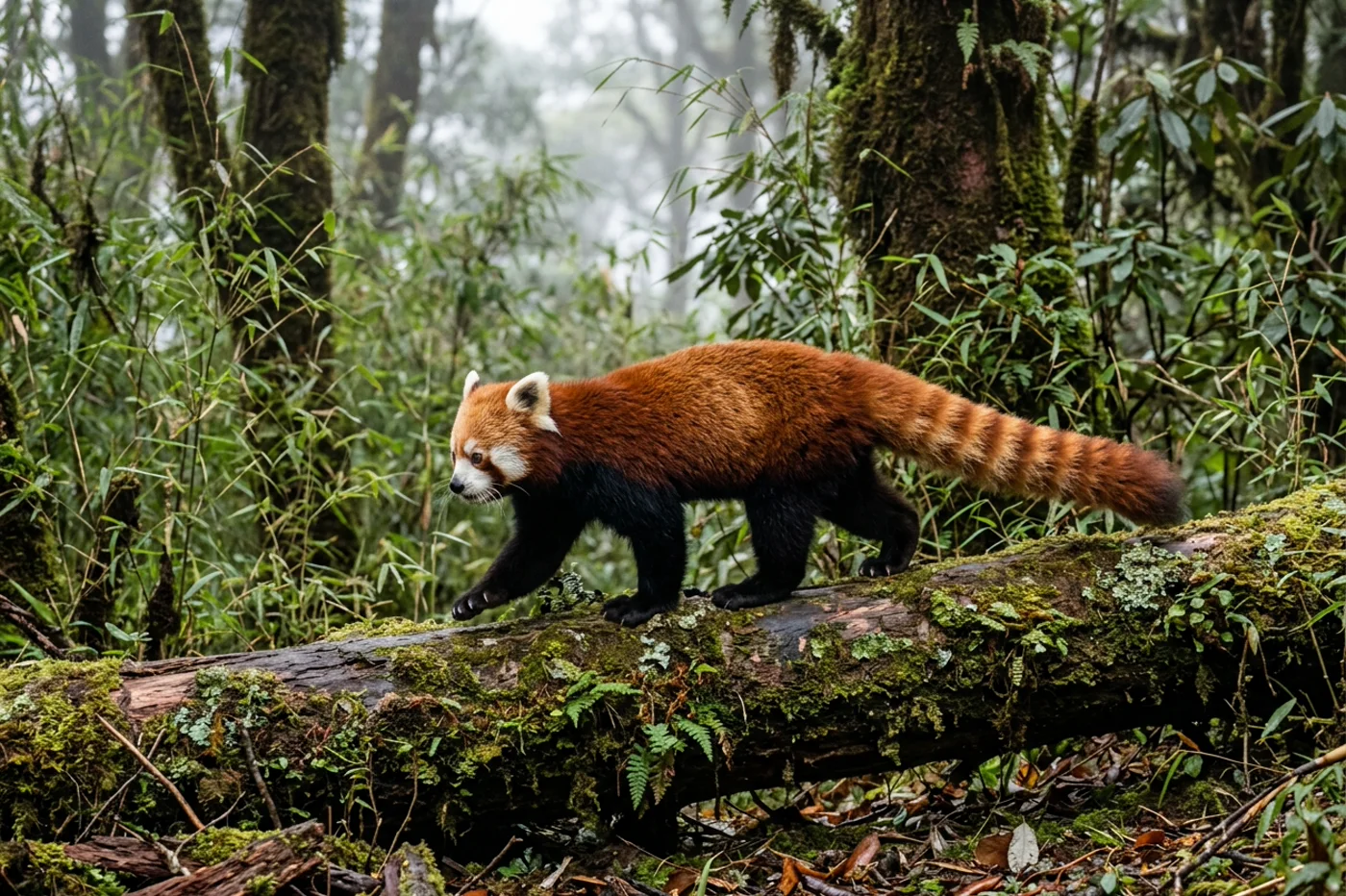
The red panda (Ailurus fulgens) is an endangered arboreal mammal endemic to the high mountain forests of the Eastern Himalayas and southwestern China. Equipped with a russet coat, ringed tail, flexible ankles for headfirst tree descents, and a modified wrist bone functioning as a pseudo-thumb to grasp bamboo, it is the sole surviving member of the taxonomic family Ailuridae.
Habitat & Range
The red panda (Ailurus fulgens) inhabits high-altitude temperate broadleaf and coniferous cloud forests across the Eastern Himalayas and southwestern China at elevations between 1,500 and 4,800 meters, with core populations concentrated between 2,200 and 4,000 meters. Nearly 50 percent of its potential habitat lies within the Eastern Himalayan belt spanning eastern Nepal, northern India (particularly Sikkim, Darjeeling in West Bengal, and Arunachal Pradesh), Bhutan (present in 19 of 20 districts), and northern Myanmar, extending northeastward into Tibet, western Yunnan, and western Sichuan in China. Genomic studies differentiate two evolutionary lineages: the Himalayan red panda (Ailurus fulgens) in the western range and Styan's or Chinese red panda (Ailurus styani) east of the Yalu Zangbu River.
How to Identify It
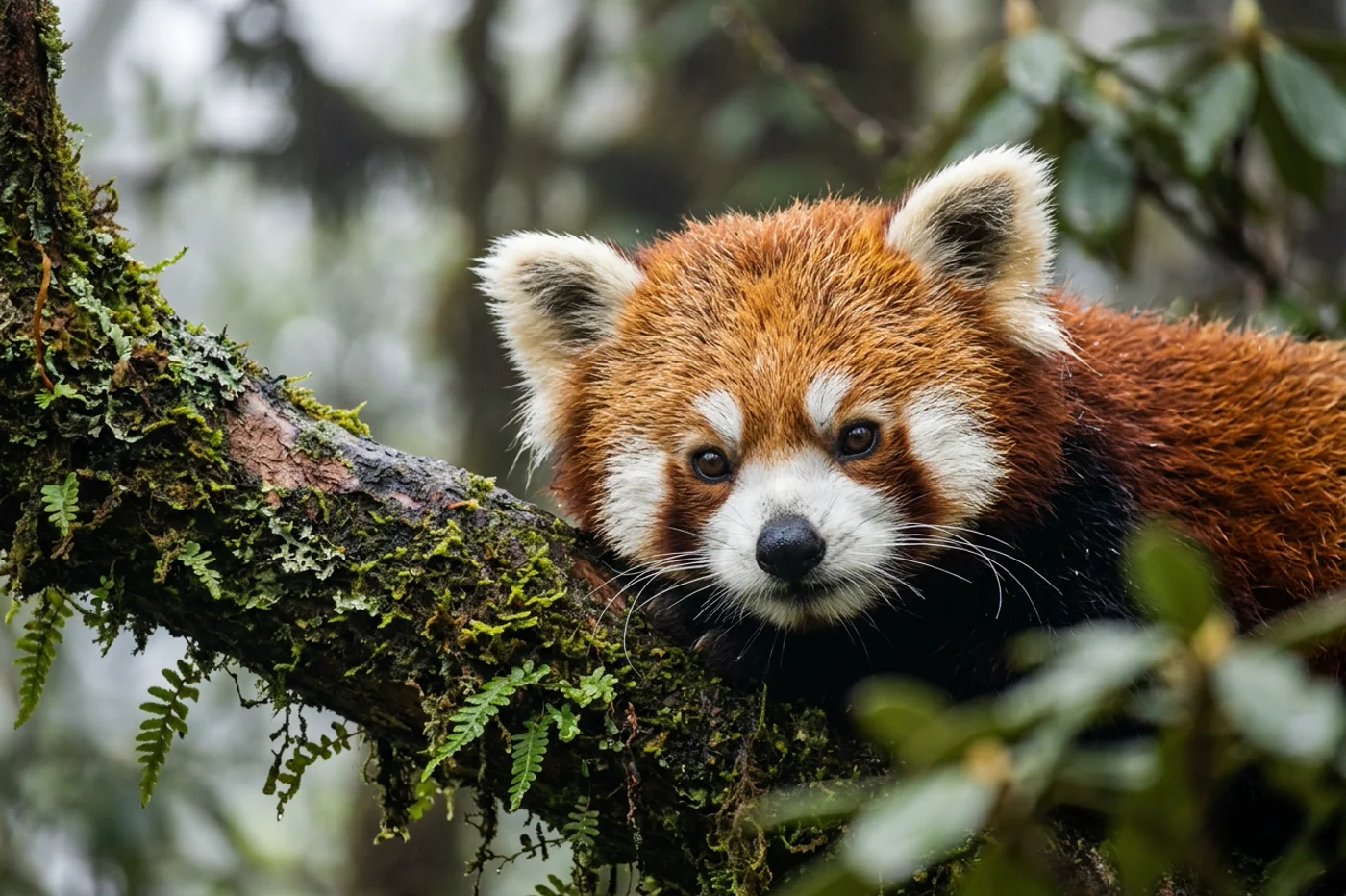
Slightly larger than a domestic cat, an adult red panda measures 56 to 62.5 centimeters in head-and-body length with a non-prehensile bushy tail adding 37 to 47.2 centimeters, and weighs between 3.6 and 7.7 kilograms without sexual dimorphism. Its thick double coat consists of soft woolly underfur shielded by coarse russet-red guard hairs on the back that blend seamlessly with clumps of reddish-brown tree moss and white lichens, while the belly and stout legs are glossy black. The round head features a shortened snout, erect white-rimmed pointed ears, and a white face marked by reddish-brown tear tracks from the eyes to the mouth. Dense white hair pads the plantigrade soles for warmth and grip on wet bark, and the tail displays roughly 12 alternating red and buff rings.
Diet & Hunting
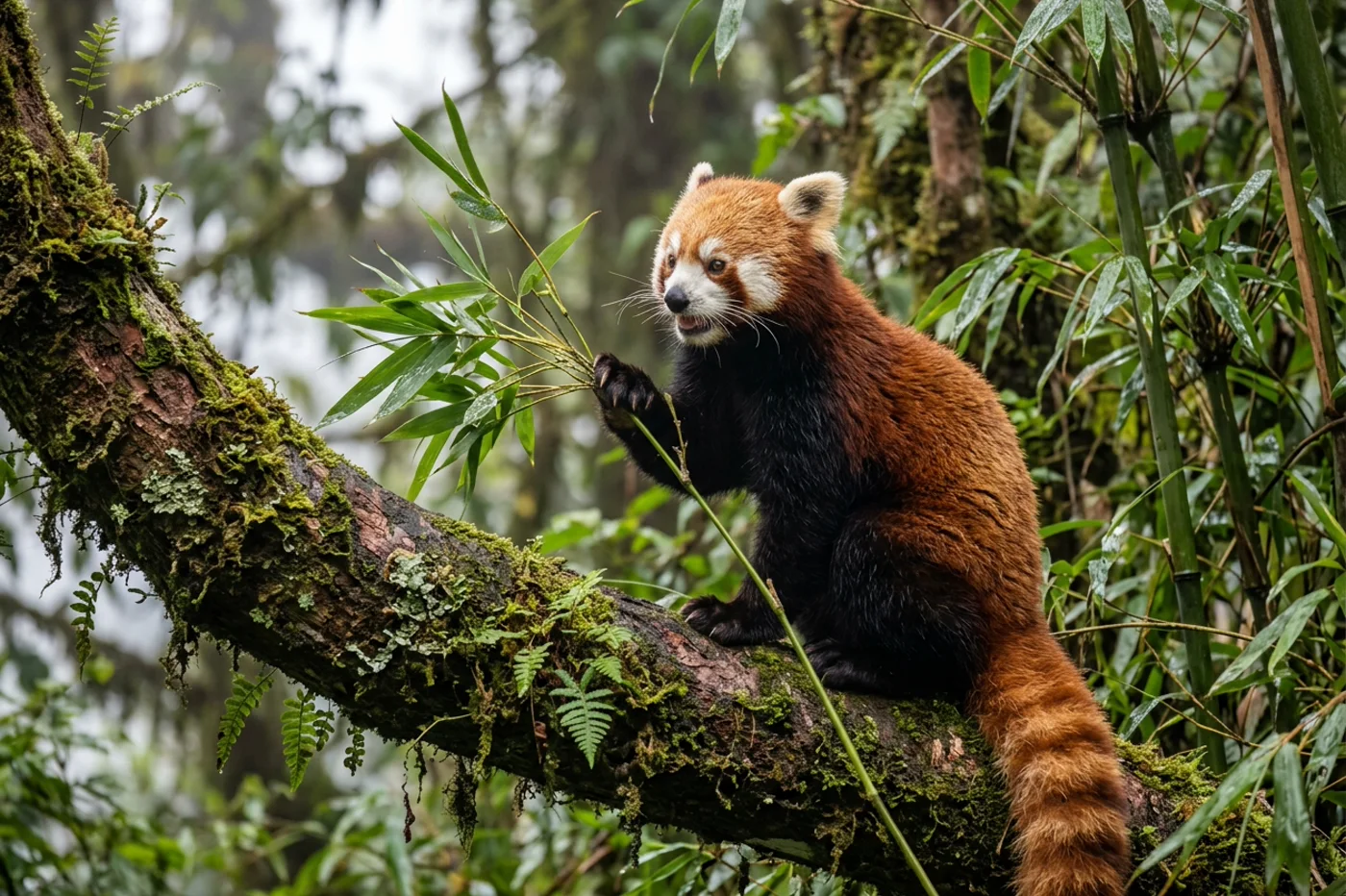
Although classified in the taxonomic order Carnivora with a simple, short carnivoran digestive tract, the red panda is a specialized folivore whose diet consists of approximately 95 percent bamboo. Unlike giant pandas that crush woody culms, red pandas cannot digest tough cellulose efficiently and must feed selectively on the most nutritious bamboo leaf tips and tender spring shoots. They grasp bamboo stems using an enlarged radial sesamoid wrist bone—a convergent pseudo-thumb—and shear leaves off with robust, multi-cusped premolars and molars. Because bamboo provides low caloric return, red pandas forage for up to 10 to 12 hours daily and supplement their diet seasonally with wild berries, blossoms, acorns, roots, succulent grasses, insects, and occasional bird eggs.
Behavior
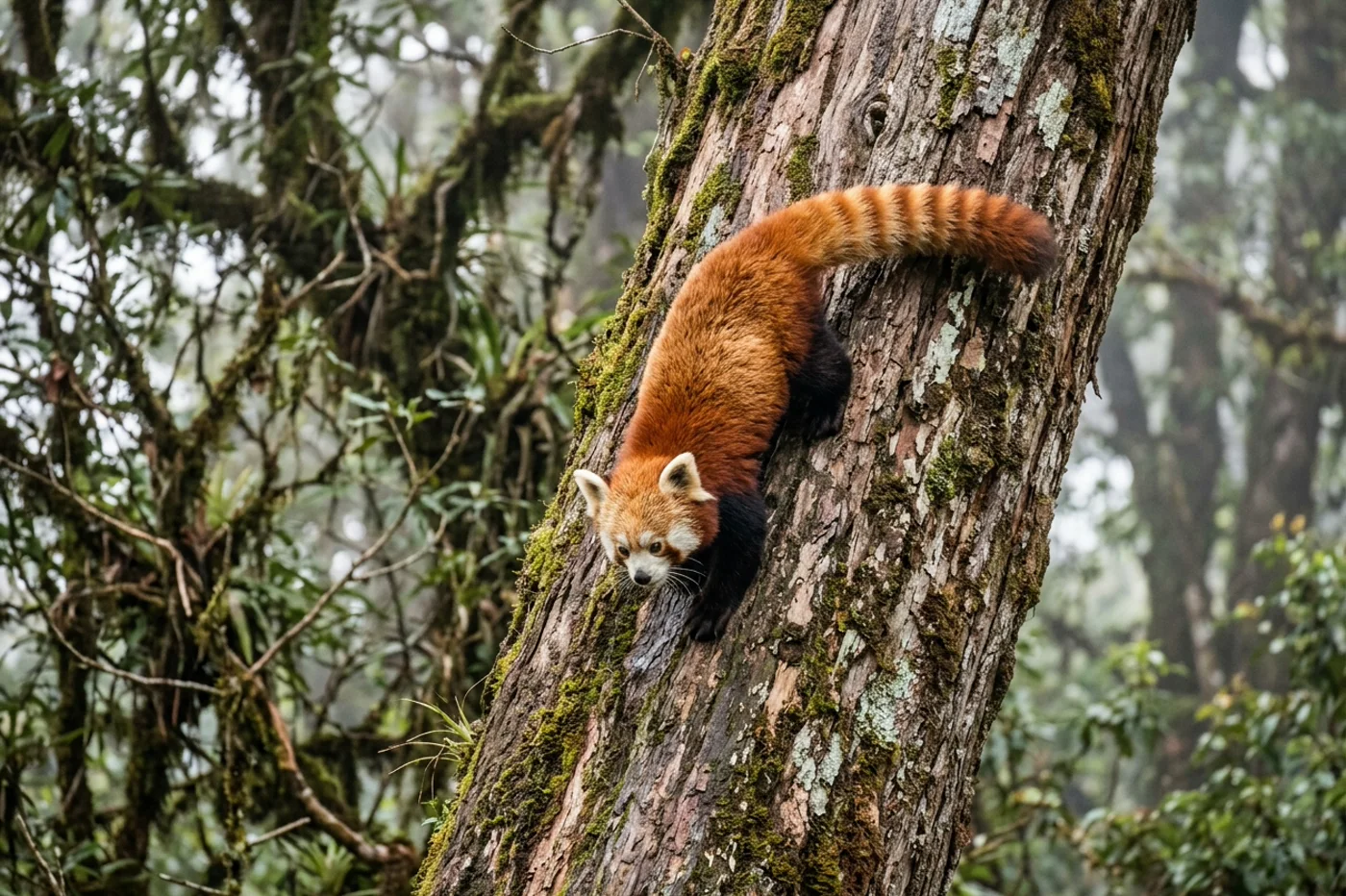
Red pandas are predominantly solitary, arboreal, and crepuscular to nocturnal, spending roughly 45 percent of each day awake and foraging most actively at dawn, dusk, and night. Their hind ankles are exceptionally flexible, with the fibula rotating around its axis on the tibia so the animal can climb headfirst down vertical tree trunks while using its long ringed tail as a counterweight and a wrap-around winter pillow. On the ground, inward-angled forelegs produce a slow cross-extension waddling gait across a home range of about 2.5 square kilometers. They mark territories using urine, anogenital glands, and odorless liquid secreted from pores between their footpads, testing chemical signals via a unique cone-like structure on the underside of the tongue.
Life Cycle
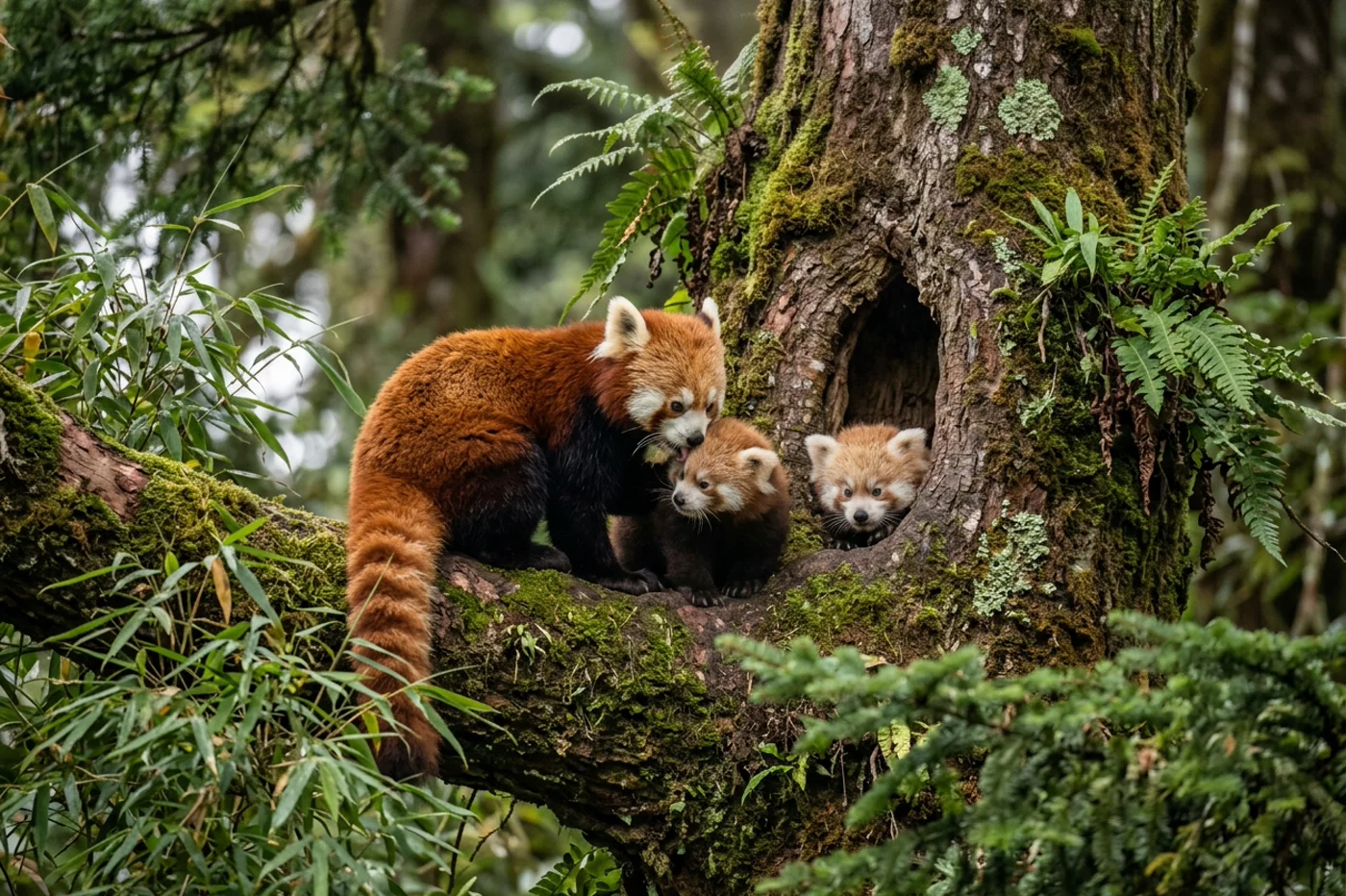
Triggered by increasing day length after the winter solstice, the annual breeding season runs from January through March in the Northern Hemisphere. Mating takes place on the ground, and gestation lasts 93 to 156 days (averaging around 134 days), incorporating a variable period of delayed implantation so births coincide with lush late-spring bamboo growth. Several days before giving birth between May and July, the female lines a hollow tree trunk, rock crevice, or stump with moss, leaves, and sticks. Litters consist of one to four furred, blind cubs (typically two), each weighing 90 to 110 grams at birth. Cubs remain nest-bound for about 90 days, nurse for several months, stay with their mother for roughly one year until the next breeding cycle, and reach sexual maturity at 18 months.
Role in the Ecosystem
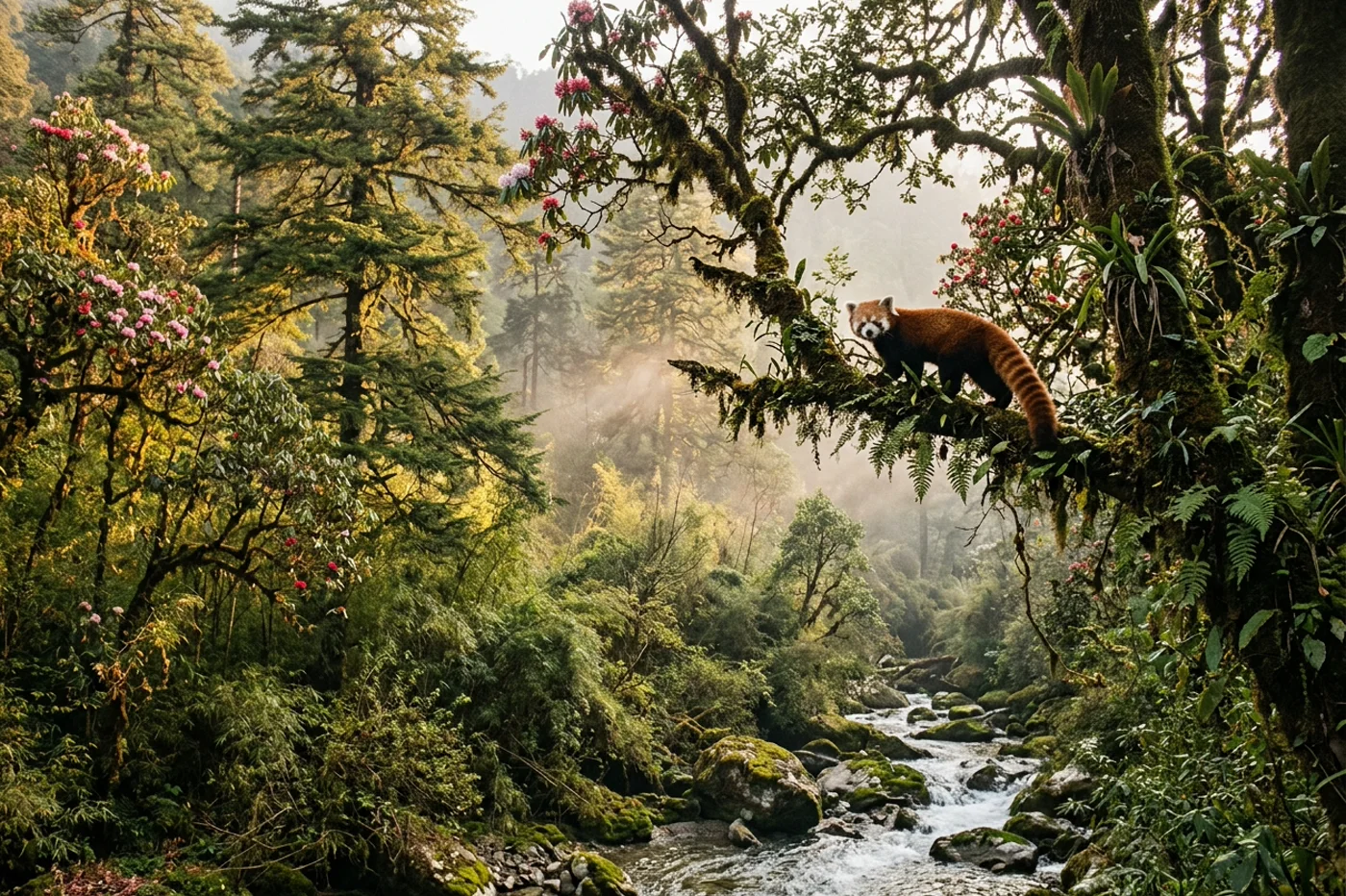
As the sole surviving species of the ancient carnivoran family Ailuridae (superfamily Musteloidea), the red panda occupies a specialized arboreal herbivore niche in montane bamboo-rhododendron ecosystems. By selectively pruning bamboo leaf tips and shoots and dispersing seeds of wild mountain berries and fruits, red pandas help regulate understory bamboo density and support high-altitude forest regeneration. They are preyed upon by apex montane carnivores including the snow leopard (Panthera uncia), clouded leopard, dhole, and yellow-throated marten, while serving as a critical bio-indicator and flagship umbrella species whose protection safeguards entire Eastern Himalayan watershed forests.
Conservation Outlook
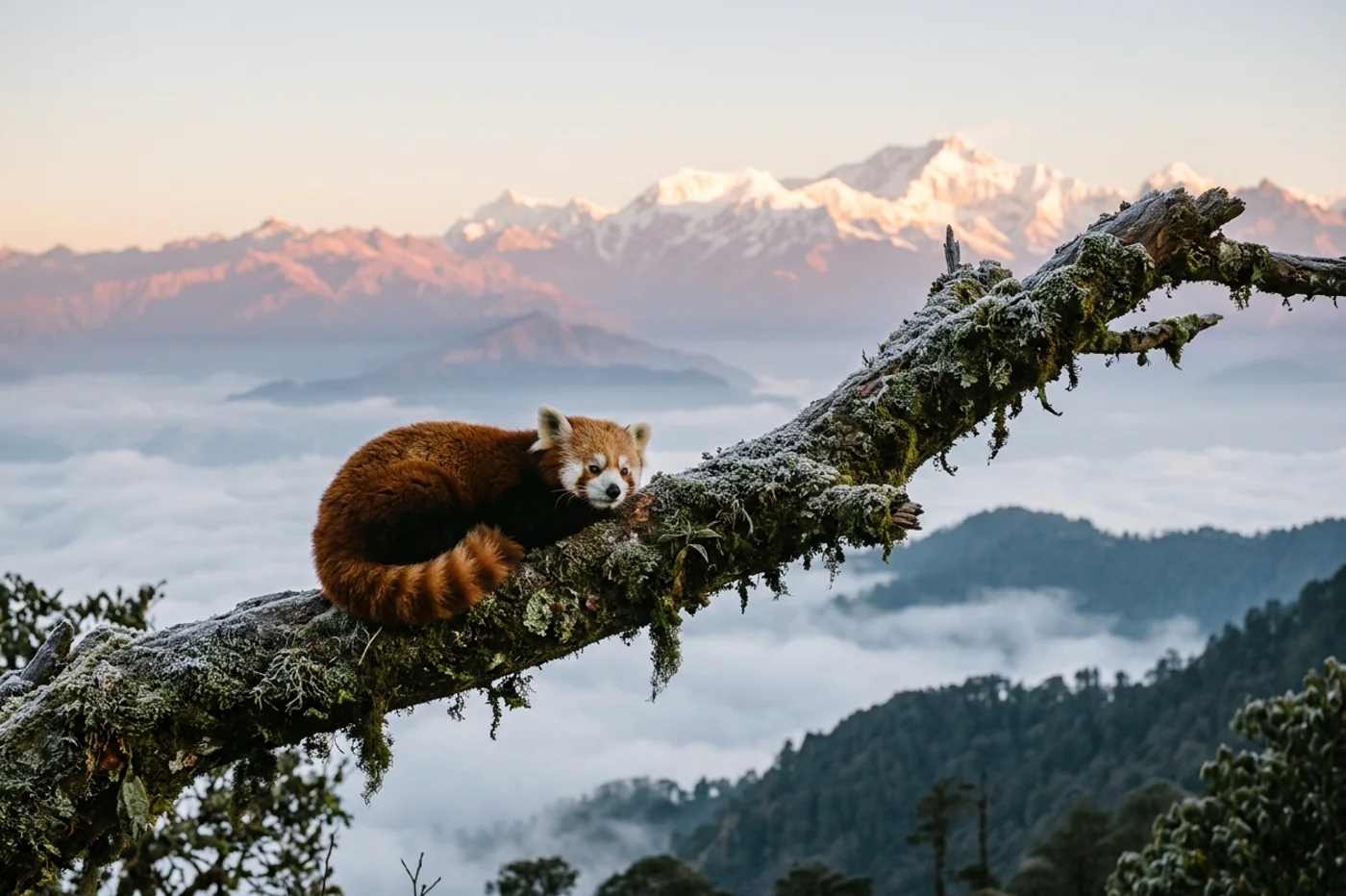
Listed as Endangered on the IUCN Red List and protected under CITES Appendix I, the global wild red panda population is estimated at fewer than 10,000 mature individuals, having declined by approximately 40 to 50 percent over the past two decades. Primary threats include deforestation for timber and firewood, habitat fragmentation by roads and agriculture, overgrazing by livestock that trample bamboo understories, accidental snaring in traps set for musk deer, illegal pet and pelt poaching, and canine distemper virus transmitted by free-ranging domestic dogs. Conservation initiatives led by WWF, the Red Panda Network, and range-country governments in Langtang, Singalila, Khangchendzonga, and Jigme Dorji National Parks deploy community forest guardians, yak-dung fuel briquettes, dog vaccination drives, and international zoo assurance breeding programs.
Key Takeaways
- 1
First scientifically described in 1825—44 years before the giant panda—the red panda is the original 'panda' (from the Nepali word 'ponya', meaning bamboo-eater) and the only living member of the family Ailuridae.
- 2
It possesses a convergent 'pseudo-thumb' formed by an enlarged radial sesamoid wrist bone to grasp bamboo stalks, along with flexible hind ankles that rotate to let it climb headfirst down vertical tree trunks.
- 3
Red pandas are the only known carnivores with a specialized cone-like structure on the underside of the tongue used to collect and test liquid scent marks secreted from glands between their footpads.